
Cutting
ABOUT WATERJET CUTTING Clean, Efficient, Environmentally Friendly
 |
 |
 |
|
What Can We
Cut for You?
|
 |

|
 |
Cost Efficient
Speed and Precision
Maximum Yield
Consistent Duplication
Unique Design Options
Superior Service
Custom WaterJet Machining
for Nearly Any Material
 |
 |
 |
A Look at WaterJet Cutting and Cutting Techniques...
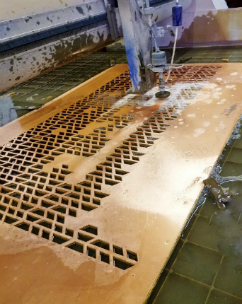
Waterjet cutting is best described as an accelerated erosion process that we control. Waterjet can cut or erode through virtually any material known, making it one of the most versatile machines ever invented.
Tolerances tighter than +/- 0.05" are achievable, especially in thinner materials such as 1" stainless steel. However, high tolerances come with a price, sometimes up to 500% higher than if the same part had been specified with a tolerance of +/- 0.05". By being more flexible with tolerances, prices will plummet as cutting speeds increase. Waterjet cutting has the ability to vary tolerances in different locations on a part, ensuring the best pricing and quality.
Thickness and Kerf
Materials ranging from 5" stainless steel to 0.010" acrylics can be cut by waterjet, making it a very versatile tool. Kerf (cutting width) ranges from 0.040" to 0.050".
Taper and Edge Finish
Taper and edge finish are directly related to cut speed. The greater the speed, the more taper and the coarser the edge finish. As the waterjet slows down, taper can be eliminated and a finish similar to 120 grit sand paper can be achieved. Again, slower means an increase in time...and price.
Waterjet cutting is a natural erosion process involving no chemicals or heat. Because of this, warping and distortion typically associated with laser, plasma and oxy-fuel cutting is eliminated, therefore minimizing the need for secondary processing.
The versatility of the waterjet allows it to be used in nearly every industry. Some materials have unique characteristics that require special attention when cutting. As you can see in the chart below, each material we cut will have some unique characteristics that have to be taken into account.

Cutting Techniques
The information below explains some of the cutting techniques we use when cutting these materials. We recognize that there are many materials not listed so if you have a specific question about your material feel free to contact us.
Alloys
With Inconel, Hastalloy, Waspalloy, Titanium, Aluminum, Stainless etc., no heat effected zone or change in the molecular structure occurs in the alloy material. There is no distortion as seen with typical heat cutting methods. Generally, cutting with waterjet costs less than traditional machining or cutting methods. In many cases, no secondary removal of slag or damaged material is necessary, and minimal to no burring is seen.
Gaskets
Using waterjet for cutting gaskets makes possible the nesting various sized and shaped gaskets on one sheet. There is no longer any need for stacks of dies. Computer assisted design (CAD) software keeps track of remnants to allow for better inventory control and later use of off-cuts for smaller parts. Our specialized machining software tracks materials through the entire process.
Laminates
Waterjet, in most cases, does not see any difference between laminated materials - e.g. acrylic, aluminum, stainless and honeycomb section all laminated as one. Many aircraft parts consist of laminated materials where waterjet is the only solution.
Steels
Waterjet is not always the most cost effective method to cut steels. As a rule, if the finished product is presently being cut using laser, plasma or oxyfuel, and no secondary work is needed to the part after being cut, it is unlikely waterjet will be an economical solution.
Rubber and Foam
Depending on the durometer value, rubber and foam can be cut with water only or with abrasive. Tests will quickly reveal what the best option is for your application.
Courtesy WardJet, Inc.
Questions? Call Gene at (405) 831-2085 or email to: gene@envisionrapidcutting.com
